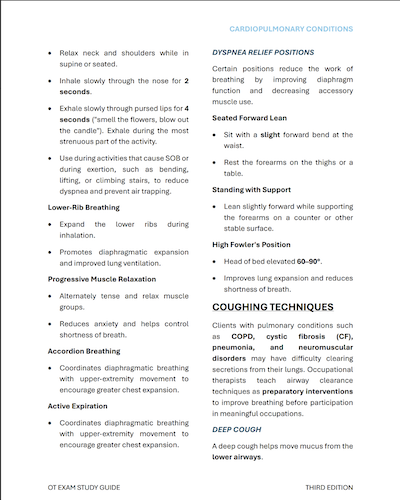

If Cardiopulmonary Conditions questions keep leaving you stuck between two answers or second-guessing what the safest intervention is, it's usually not because you don't know the diagnosis.
It's because cardiopulmonary conditions are all about clinical priorities.
The NBCOT® exam expects you to recognize what matters most right now—when to treat, when to modify, when to stop, and how cardiac or pulmonary status changes every clinical decision.
This guide helps you organize those priorit... ...
If Cardiopulmonary Conditions questions keep leaving you stuck between two answers or second-guessing what the safest intervention is, it's usually not because you don't know the diagnosis.
It's because cardiopulmonary conditions are all about clinical priorities.
The NBCOT® exam expects you to recognize what matters most right now—when to treat, when to modify, when to stop, and how cardiac or pulmonary status changes every clinical decision.
This guide helps you organize those priorities so cardiopulmonary questions become much more predictable.
Inside you'll find:
✅ 80+ flashcards covering cardiac and pulmonary conditions, vital signs, MET levels, Borg RPE, interventions, precautions, cardiac procedures, devices, and more
✅ 40+ practice questions that teach you how to make safe clinical decisions with cardiac and pulmonary conditions
✅ Simple, high-yield breakdowns of cardiopulmonary concepts without unnecessary medical jargon
Because passing the NBCOT® exam isn't about memorizing every diagnosis.
It's about recognizing when a patient is medically stable, identifying the highest priority concern, and selecting the safest occupational therapy intervention.
This guide helps you connect medical knowledge to clinical reasoning—so cardiopulmonary questions feel less overwhelming and much easier to answer with confidence.